Observation Session 13th March 2018

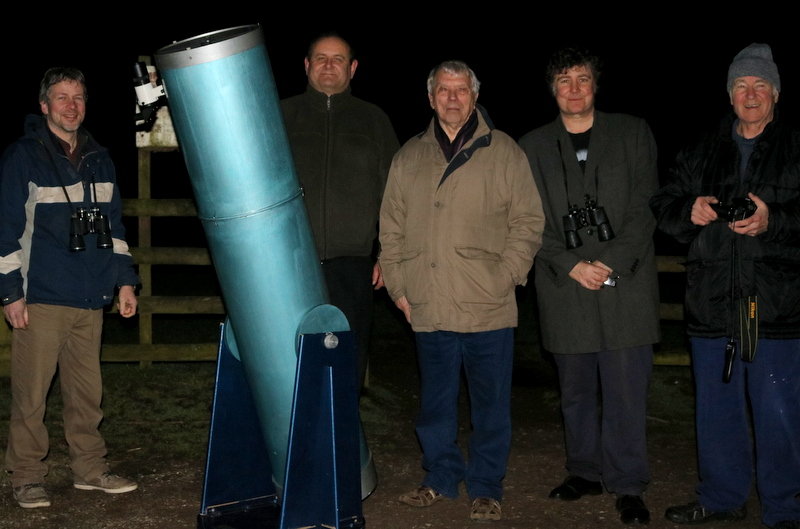
Members with the Tom Collier telescope

By Richard Harvey

After what seemed like years of cloudy skies, we were finally able to hold another society observing session at Trysull on the 13th March. Despite a slight misty haze in the sky, we were lucky enough to see some true celestial wonders once again.

The society’s Tom Collier 12-inch reflecting telescope had been collimated by society member Dave Wilson at a recent Monday Highfields meeting, so we were looking forward to putting the newly aligned optics to the test. This was the telescope’s second trip to the observing site, although its first visit was scuppered by clouds, (on that occasion, two weeks previously, society members Cath, Linda, Dave, John, Doug and I were forced to abandon thoughts of observing and abscond to the nearby pub).

Read more

Farewell to David Towers

Last week we had to say goodbye to one of our long term members, David Towers, who is moving away from the area. David has been a dedicated member of the society for 14 years, and during that time he has barely missed a meeting!
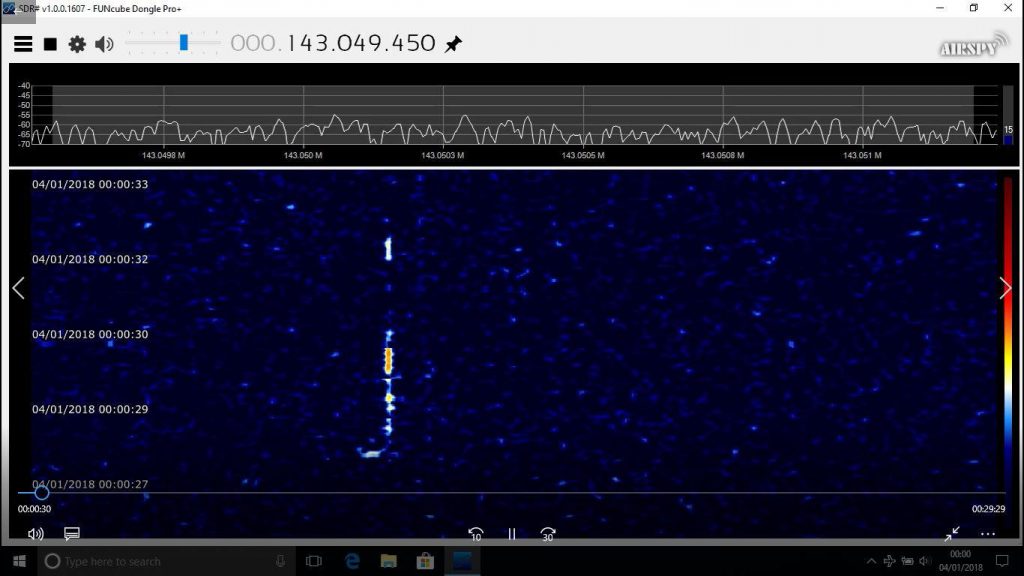
Many of you who were with us when we met at Beckminster will fondly remember David entertaining us on the piano at the start of meetings, as well as his excellent knowledge of amateur radio, and great sense of humour. Behind the scenes, he also gave up his time to help us set up many of the Paul Pope lecture events at St Peter’s, for which we are very grateful.

We are sad to see him go, but we wish David all the best for the future.

Read more

Observation Session 28th November 2017

By Richard Harvey

Members' telescopes

It was a case of ‘third time lucky’ for our new Trysull Observation Sessions. Two consecutive Tuesdays were postponed due to 100% cloud cover, but at last, the forecast was promising on Tuesday 28th November, and at 11am that morning, the text notification system informed everyone ‘it’s on!’

Members' telescopes

People started arriving at the Village Hall at 8pm. It was very encouraging to see such a good turnout. Around twenty astronomers of all ages and experience braved the crisp November night, and soon there was a row of telescopes set up, scanning the near-cloudless Trysull sky. Not everyone bought a telescope, but they didn’t need to. The telescopes there were used by everyone, and people drifted from scope to scope, looking at various cosmic sights, chatting about what they were looking at. It was a very friendly, convivial evening. At one point, as many as eight different telescopes of various sizes were in use on the large expanse of hard-standing behind the village hall.

Read more

Winter 2017-8 Night Sky Guide

This PDF guide, produced by Simon Barnett, gives details of what you can see in the night sky over Wolverhampton this winter.

2017-8 WINTER – WOLVAS NIGHT SKY

Simon has produced some amazingly detailed and thorough sky guides for us over the years, but sadly this will be his last one. We are incredibly grateful for all his hard work, and I hope that many of you have found them useful during your observing.

Read more

The Great American Eclipse

By Richard Harvey

Pic 0 - The Great American Eclipse
Pic 0 – The Great American Eclipse

The solar eclipse on the 21st August 2017 was the first eclipse on mainland America since 1979, and the first eclipse since 1918 to travel completely across the American continent. Given the increases in population and the land mass concerned, (it crossed fourteen states, and the path of totality covered 14% of US soil), it’s been estimated that it was the most viewed eclipse in human history. It’s little wonder then that it was called ‘The Great American Eclipse’. (picture 0)

My eclipse trip started at Heathrow on the 18th August. At 6am that morning there was a beautiful clear sky that presented a thin crescent waning moon by Venus, (my camera was packed away, so I didn’t get a photo). With only three days to go before the eclipse, as I watched the moon rise outside the airport I pondered on how the crescent would get even thinner over the next few days, till the moon would seemingly vanish from the sky and be completely ‘backlit’. It does this every lunar month of course, but this particular month, the moon’s position in the sky meant that it would move directly in front of the sun at 1.34pm on Monday, and weather permitting, grant us one of the finest astronomical treats.

Read more

Summer 2017 Night Sky Guide

By Simon Barnett

This PDF guide, produced by Simon, gives details of what’s visible in the Wolverhampton night sky this summer, along with details of the moon, the planets, and full details of the upcoming solar eclipse!

2017 SUMMER – WOLVAS NIGHT SKY

If you want more information on what is visible, or you want it for an observing location other than Wolverhampton, why not look at our Links page which has details of useful resources, such as Stellarium, the free planetarium software.

Read more

A Promising Start To The Year? Some 2017 Observations

By Richard Harvey

After a very cloudy 2016 winter, we’ve at last been afforded a handful of clear skies for the first few months of 2017. For some reason, Wednesdays seem to be the night we’ve had the most clear skies, with the weekends typically clouded over. This is most irritating for those for astronomers with 9-5 weekday jobs, it seems we’re always at the whims of nature!

Venus through 8” Skywatcher in January and February 2017
Photo 1 – Venus through 8” Skywatcher in January and February 2017

Venus has been putting on a superb show in the early evening sky, rising very high through February, and presently, (I’m writing this on 17th March), is heading lower in the Western sky. When it’s so visible, most amateur astronomers often get friends asking “what was that bright star I saw last night?” I’ve been asked several times over the past couple of months.

I took some photos of Venus through my 8” Skywatcher in January and February, and was pleased to be able to capture the both the changes in the apparent size and phases of the planet, as it gets nearer to us on its journey round the sun, (photo 1). On the 5th January it was approx 111,000,000 km away from the Earth, and on 26th February approx 54,000,000km away. It always fascinates me that Mercury and the Venus are the only planets that show Moon-like ‘phases’, being closer to the Sun than us.

Read more

Summer Observations Part Two

By Richard Harvey

Deep sky observing in the summer can be quite a challenge. When we talk about ‘deep sky objects’, we’re generally referring to things like Nebula, star clusters, galaxies etc, pretty much everything that’s not a single star or a planet. The astronomer Charles Messier made up a list of the most interesting deep sky objects and we still use his listings and his ‘M’ numbers today. These objects can sometimes be quite faint, and when the sky is bright they can prove elusive, but it’s worth the hunt. Messier objects are some of the most fascinating things in the night sky.

Looking west after sunset, towards Corona Borealis and Bootes
Picture 1 – Looking west after sunset, towards Corona Borealis and Bootes

The constellation photographs I’m using to illustrate this article were all taken by me this year using a Fuji XF1 (which is a small compact camera, not an SLR) on a small tripod. Most shots were between 20-30 second exposures at f1.8 and 100ISO, using a two second timer to eliminate camera shake, (picture 1) shows the area of sky looking west after sunset, towards Corona Borealis and Bootes). To locate the deep sky objects in this article, I’d recommend a sky-atlas. My favourite is ‘Turn Left at Orion’, published by Cambridge press.

Amongst the first stars you see in the summer, as the sun sets and the sky darkens, are the stars of the ‘Summer Triangle’. Deneb, Vega and Altair, in constellations of Cygnus, Lyra and Aquila respectively. Vega shines right overhead in Summer, a bright beacon, and it’s always a welcome sight. Four stars near it form a ‘squashed box’ shape that makes up the constellation of Lyra, and in between two of these stars is M57 – the famous Ring Nebula.

Read more

Summer Observations Part One

By Richard Harvey

As the summer equinox approaches, it brings with it the onset of long daylight hours, and short, hazy, night-time summer skies. Many amateur astronomers screw their lens caps on tightly, and their telescopes go into hibernation till the winter. I’ve always thought this a bit of a shame; the summertime night sky can deliver some lovely astronomical sights. With this in mind, I thought I’d write a little about my own observations over the 2016 summer for Lyra, some of which will hopefully be of interest to society members.

Observing site
Picture 1 – Observing site

First, a bit of background about my observation sessions & equipment. I live in Chapel Ash, which unfortunately suffers from quite severe light pollution from the nearby city. Realising I needed to get away from the city lights to do any decent deep-sky astronomy, three years ago my dad and I renovated an old shabby ten-foot caravan, which I now use primarily for music festivals and astronomy (picture 1). It’s become an invaluable companion for my observing sessions. In it, I fitted a cooker, a heater, and the dining table folds down into a comfortable bed. It’s an ideal all-year round base. In the winter, if I get cold observing, I can nip in the caravan to get warm, and have a coffee or a wee dram whilst poring over my star charts.

Read more